What happened when the man who took a million photographs embraced colour?
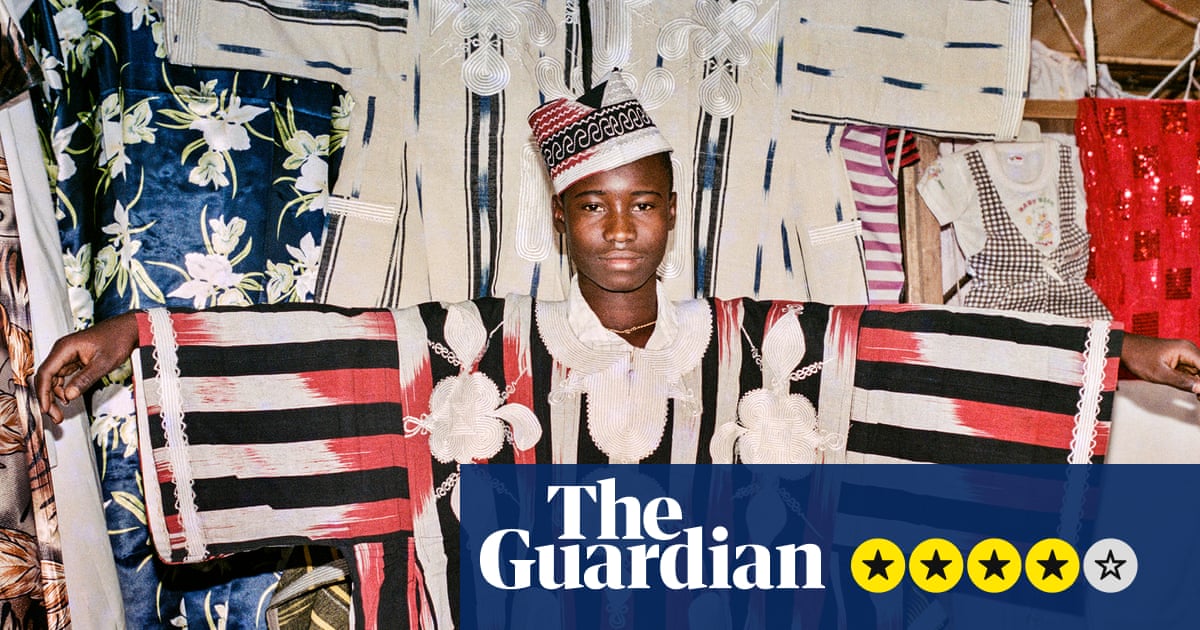
Despite his wide renown, there have been hardly any major exhibitions of Sanlé Sory’s work. His last UK show was in 2019, concentrating on the black-and-white images the Burkinabé photographer made in the first two decades after opening his own studio, Volta Photo, in Bobo-Dioulasso in 1960 – a period that coincided with the first two decades of independence in Burkina Faso. This new Photographer’s Gallery show shifts the focus to the 1980s and 1990s, when Sory began working in colour.
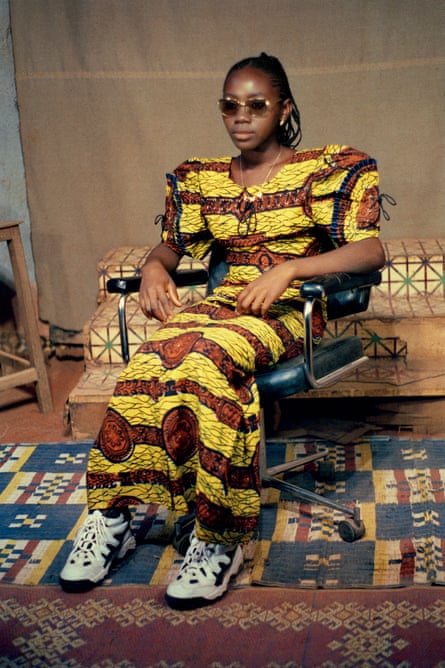
It’s easy to see why, even with few exhibitions, Sory has made such an impression on audiences. There are the familiar west African studio photography tropes westerners love, where sound, image, fashion and pose collide. The props are popping, the style is irrepressible, the energy is irresistible. I wonder if Sory’s speed and instinct came from the time he spent early in his career racing on his motorbike to photograph car accidents for newspapers and the police. These portraits are the opposite of a car crash, they’re remedially joyful, wilfully alive – but they share that feeling of being inside the moment, at the edge of something.
The works here also bring out the insouciance and humour in Sory’s portraits. In a wall of selected studio photographs, reprinted from negatives in his archive, the poses are sometimes gloriously over the top: fingers pointing skywards, a fake phone held to the ear, an imitation of Grandmaster Flash. It’s all about the mash-ups: a girl in a traditional pagne paired with Nike Air Slants. Sory seems to encourage his subjects to take their fantasy roles as far as they can – the bolder, the better. Driving a motorbike into the studio? No problem. One man is almost transformed into a sculpture, draped in ceremonial, traditional and western fabrics, a religious portrait held tightly to his chest and one clenched fist raised. But Sory can be understated, too: a young man in a leather-shoe shop in the market, one leg kicked out to the side as he holds up one of the shop’s models.
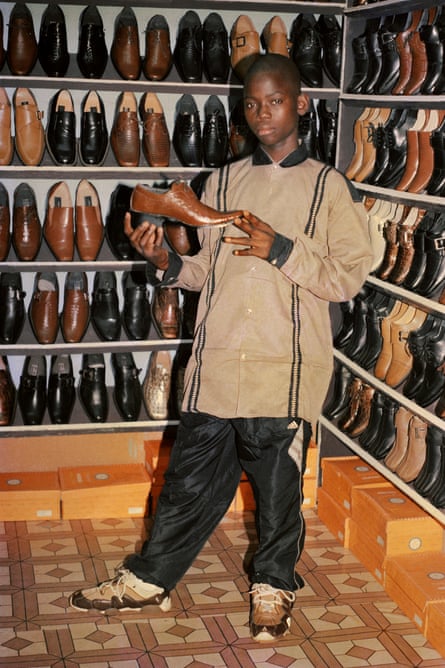
It’s thought that Sory has taken more than one million portraits; at Volta Studio’s peak, 250 people would come to be photographed every day. In the 1970s, Sory had his subjects stand against specially commissioned painted backdrops – an Ivory Coast beach setting, an aircraft boarding bridge, a generic north American city – familiar but fantastical, for his clients to project themselves into. A few of those examples are included here, in black and white, too. In the colour studio portraits here, the backdrops are replaced with a simple brown curtain, and prismatic patterned rugs, shifting the focus back to the people in front of the camera, to the here and now. If they wanted, Sory loaned his clients clothes or props; but what he couldn’t give them is the attitude. In a vitrine in the back room, there’s a small collection of original prints given to clients who came to the studio – their album-size scale totally changes the picture, and reminds you of the purpose of these keepsakes: private souvenirs for personal histories, loved ones. Enlarged and displayed on the gallery walls, they become something else – something that reaches beyond the individual.
At night, the buzz of the studio blurred seamlessly into long nights on the dancefloor. As well as creating record sleeves for groups such as Dafra Star, Orchestre Volta Jazz, and Echo Del Africa, Sory was also an organiser of DIY raves around Bobo-Dioulasso, known as bals poussières (dust balls). As he recounts in his 2017 book, Sanlé Sory: Volta Photo 1965-85: “I would drive down to some remote village in the bush and set up a player, a few records, some loudspeakers and a few lights and get the party going. We started around 8pm and people would tell me, ‘Sory, you need to set the place on fire!’ It would go on until 5am.” Of course, the party became a Sory photoshoot, too. Like Malian master Malick Sidibé or Ivorian photographer Paul Kodjo, Sory was attracted to photographing people when they were at their loosest and most free. Liberation looks like people dancing. Sory photographed like a jazz musician, improvising, feeling, riffing off the energy in the room.
The move to colour, which began in the 1980s, amplifies every compositional and stylistic element of Sory’s portraits. It brings yet more life, if that were possible, to pictures already bursting at the seams. This was also the iconic era of Thomas Sankara in Burkina Faso: the revolutionary, Marxist and pan-Africanist, who was also a jazz musician, came to power in 1983 before being assassinated in a coup led by his former comrade Blaise Compaoré. Sory’s images of this period seem to embody Sankara’s messages of pride, self-reliance, courage and non-conformity. You can hear the echoes of Sankara’s famous slogan: “La patrie ou la mort, nous vaincrons!” (Homeland or death, we will overcome!)
The biggest problem with this exhibition, really, is its size. It offers a tantalisingly small taste of the six-decade long Sory story. Around 20,000 negatives survive, as Sory had begun burning parts of his archive when he was rediscovered in 2011. A slideshow projection running in the back room attempts to give more of a sense of its scale, but it is no substitute for spending time with the photographs themselves. The colour pictures offer an entirely fresh perspective on this exuberant, intoxicating body of work. But you leave wanting more.
Материал изданияThe Guardian Culture
Читать в оригинале