Chasing storms and Baltic gold: Lithuanian retiree’s passion for amber fishing
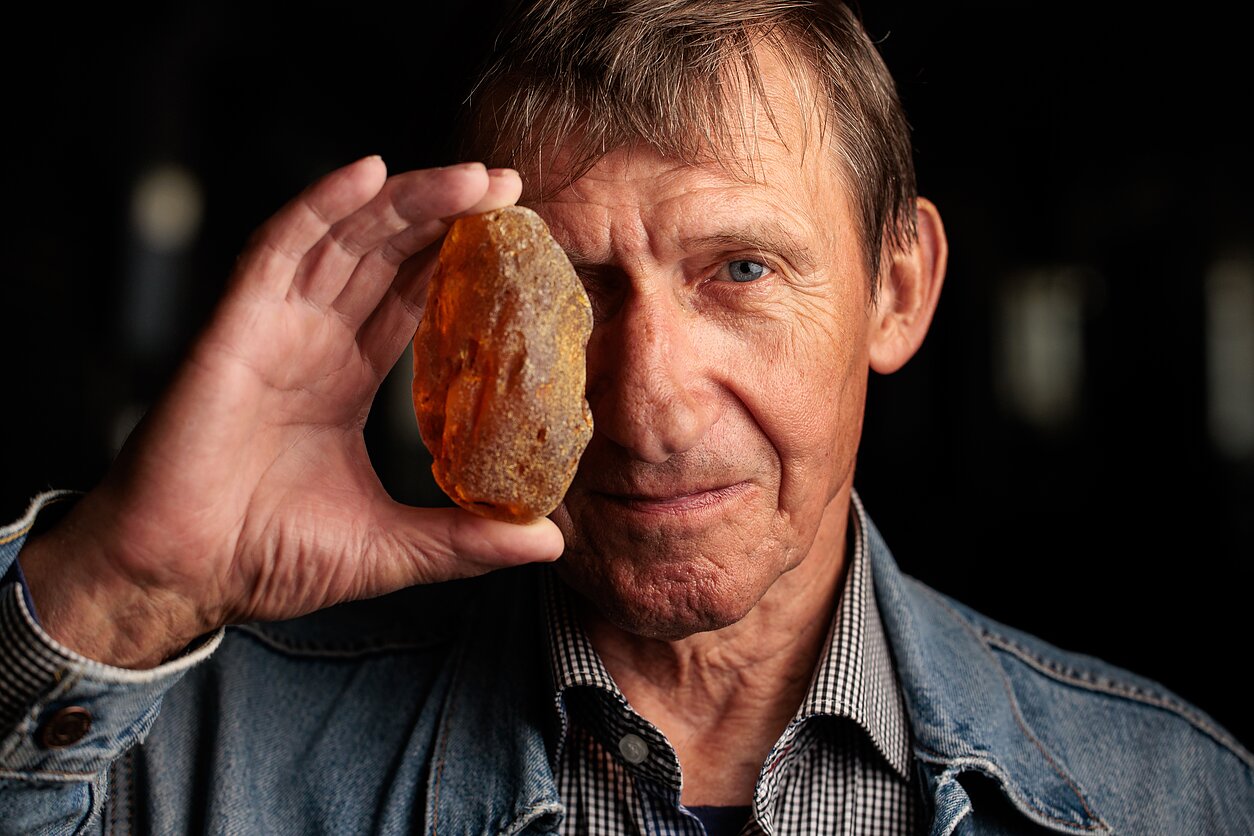
When retired Vilnius resident Romualdas Petruškevičius hears forecasts of a storm along Lithuania’s Baltic coast, he gets excited. Rough seas could mean one thing: amber washed ashore by the waves.
He is willing to drop everything, travel to the coast and spend a sleepless night wading through cold autumn waters in search of the golden stones. He makes no money from his unusual hobby, although he could, but says the excitement of finding amber is reward enough.
“I check the weather forecasts constantly. When I hear there has been a storm, I know there might be amber on the shore,” Petruškevičius told LRT.lt.
A former forester, he has been collecting amber – officially known in Lithuania as amber fishing – for more than a decade. It all began by accident.
Once, while walking along the coast near the Latvian border, he spotted a handful of yellow stones on a pile of rocks. He collected them and asked kiosk vendors whether they were really amber, finding it difficult to believe.
Another discovery came during a winter walk with his wife near the Palanga bridge, when a wave deposited a sizeable piece of amber right at their feet.
“Those experiences hooked me and made me want to take amber fishing more seriously,” he recalled.
Following the waves
These days, Petruškevičius does not leave his discoveries to chance. He closely follows weather forecasts and wave conditions, using an app originally designed for surfers that provides information on wave heights and intervals.
He has invested in the necessary equipment: a long-handled net, waist-high rubber boots, a waterproof jacket and a special ultraviolet flashlight. Under its light, amber glows at night, easy to distinguish from ordinary stones.
During the day, he uses his net to pull piles of seaweed, driftwood and other debris onto the beach, then searches through them for amber.
The best opportunities usually come a day or several days after a storm, when the sea remains unsettled and produces waves capable of bringing treasures from the seabed. The ideal waves are between half a meter and a meter high, with several seconds between them.
Autumn and spring are particularly promising seasons, he says, because the chances of finding amber can be greater than in summer.
A sleepless night in Šventoji
Petruškevičius has found amber along much of the Lithuanian coast, from Palanga to Karklė, Šventoji and Klaipėda, as well as near Pape in Latvia. But trips are not always successful. Sometimes he travels all the way from Vilnius only to return empty-handed.
Two months ago, he bought an apartment in Šventoji to avoid constantly spending money on accommodation. He also purchased an electric bicycle to reach promising stretches of coastline.
One of his most memorable experiences happened in Šventoji at about 2 o’clock at night.
“I saw that the sea was washing amber ashore along a stretch of a couple of hundred metres. The water was practically yellow. I collected it all alone until six in the morning and ended up with about a kilogram,” he said. “That night was an especially beautiful experience.”
His passion has occasionally brought him into disagreements with lifeguards, particularly when he searches in cold weather. He argues that amber fishing is recognised as part of Lithuania’s intangible cultural heritage and should be allowed to continue as a traditional activity.
A treasure he prefers to keep
Unlike commercial collectors, Petruškevičius has little interest in selling his finds. He keeps them at home in vases and small dishes, occasionally giving individual pieces to people who appreciate them.
Every time he arrives at the coast, he greets the sea. When he leaves, he says goodbye and thanks it for its gifts.
“Amber fishing is an incurable disease, but I don’t want to recover,” he said.
“What makes me happy is the process itself: finding amber among the seaweed and rubbish, picking it up and holding it in my hands. Then, when I get home, I examine it under a microscope to see whether it contains any inclusions. It is food for the soul. And it becomes addictive – you always want to find more.”
His collection includes about 10 pieces containing inclusions – tiny prehistoric organisms preserved in amber. Every spring, he also visits the Amber Trip exhibition, where he particularly enjoys looking at creations made from natural, unprocessed amber.
Dreaming of a lifetime discovery
His largest find so far weighs 143 grams, an unusually large piece by Lithuanian standards. He discovered it this summer between Palanga and Karklė, even though there had been no major storm.
But he is still dreaming of something bigger or more unusual.
“I once asked an experienced jeweller who works with amber what the most valuable find could be. He said perhaps a piece containing an inclusion with a little lizard. I don’t even know whether such amber exists, but that is how my dream began,” he said.
“People talk about wanting to catch the fish of their lifetime. I want to find the amber of my lifetime.”
People often ask him how they can find amber themselves. His advice is simple: Go to the sea.
Others ask when he will have enough amber to build his own Amber Room. His answer is characteristically modest: He already has enough to make an amber-covered stool.
Petruškevičius always carries several pieces of amber in his pocket. He enjoys feeling their warmth and what he calls their aura, knowing that the stones are about 50 million years old.

LRT EnglishNewsletter Every Friday morning.
Материал изданияLRT English
Читать в оригинале