Hitler under the Christmas tree? Seriously? – opinion
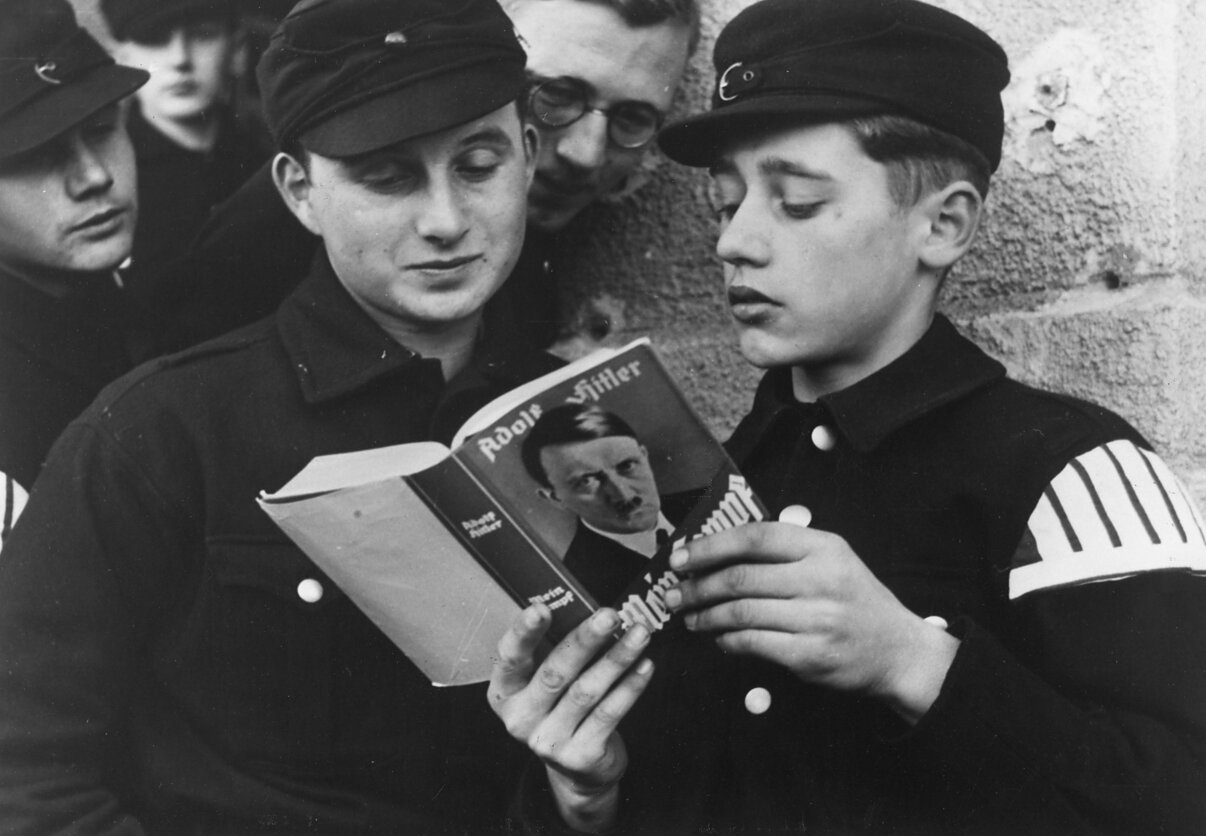
A Lithuanian publishing house is planning to publish a new edition of Adolf Hitler’s Mein Kampf. That is not a good idea – and the publisher’s arguments about understading evil sound hollow, argued Dario Martinelli, a professor of history and theory of arts at Kaunas University of Technology.
I am Italian, so I have seen this film before. On 11 June 2016 the Milan right-wing daily Il Giornale offered its readers a copy of Mein Kampf, as the first volume of a series on the Third Reich. The slogan was elegant, almost Jesuitical: conoscere per rifiutare, “know it in order to reject it”. The Prime Minister, who, back then was not Giorgia Meloni (who belongs to a party of neo-fascist extraction) but the moderate liberal Matteo Renzi, called the operation “squalid”, the Jewish community called it indecent, the Israeli embassy said, with diplomatic – or perhaps sarcastic – restraint, that “there are better books for understanding the Shoah”. The image that stayed with me, though, came from a small newsagent in the province of Bergamo, who made the news for taping a handwritten sign to his kiosk: “in this shop we do not take orders for, and do not sell, Mein Kampf”.
Ten years late, the film is screened again, this time in Vilnius, with Lithuanian subtitles and a far more expensive ticket. The publishing house Obuolys has announced the first Lithuanian edition of Hitler’s book. Its justification, sent to the press agency ELTA, could have been copied from the Milan editorial: ignorance is no protection against propaganda. Basically: know it in order to reject it.
I shall not mince words, and I will declare straight away that a) I find this publication a shame, b) I think it should have not published in the first place, and c) if the law cannot stop it, then Lithuanian society should.
Let us start by describing what exactly is being sold. The Obuolys edition is a “critical” one. It is an 800-page hardcover translating the Polish edition prepared in 2021 by the historian Eugeniusz Cezary Król, with more than 1,500 footnotes and comments. The translator is Jolita Navickienė. The Lithuanian introduction is by Dr Arūnas Bubnys, head of the Genocide and Resistance Research Centre, who also checked the historical accuracy of the translation. The publisher says the book is dedicated to the memory of the victims of the Nazi regime, as a lesson for future generations, and it plans a public launch with Professor Król, to which the Jewish community and Holocaust scholars will be invited.
The price is €129, with a discount for members of the publisher’s club. The print run is 1,000 copies. On the website, shipping is expected around 10 December. The reason given for the timing is the centenary of the second volume of Mein Kampf. A centenary. You know, just like the birth of a composer, the founding of a university, the first edition of a great novel. So, hey, why not celebrating also the hundredth birthday of a blueprint for genocide with a hardcover edition?
Obuolys justly remarks that critical editions already exist in Germany and Poland, plus the text circulates freely on the internet anyway. And to those who fear that the Kremlin will exploit the publication (perhaps to “denazify” Lithuania?), they reply that Kremlin propaganda does not need facts, and that letting Moscow decide what Lithuanians may read would mean handing it the keys of our libraries.
The German edition of 2016 was produced by a public research body, the Institute for Contemporary History in Munich, after seventy years in which the state of Bavaria had used its copyright precisely to keep the book out of print, and after years of public debate. It came in two volumes with some 3,500 annotations. The Polish edition appeared in 2021, before Russia's full-scale invasion of Ukraine, a point the philosopher Gintautas Mažeikis has made very clearly. The Lithuanian edition, by contrast, comes from a commercial house whose translations twice received the anti-prize of the Lithuanian Literary Translators’ Union for the worst translations, and which, at the Vilnius Book Fair in 2020, presented the first Lithuanian translation of Mao's Little Red Book. On that occasion its project manager said they had also considered Mein Kampf. So the idea has been in the drawer for six years, waiting for the right moment. The historian Algis Bitautas has wondered if the aim is to understand, to profit, or even to provoke. My take is that the three are not mutually exclusive.
As for “it’s on the internet anyway”: so are bomb-making manuals, Holocaust-denial material and underage pornography. The availability of something somewhere has never obliged anyone to add more of it.
The word that will be used against people like me is, of course, “censorship”. Freedom of speech, freedom of the press, freedom of research. I take these words seriously. I have spent much of my academic life writing about protest songs, about artists persecuted by regimes, about the Singing Revolution in Lithuania, about the right to say unpleasant things to power. Plus, just very recently the communication department of my university flatly refused to spread another article of mine because I called Trump and Netanyahu “authoritarian leaders”, and that for them was “controversial”. What a joke.
Thus, precisely because I take freedom seriously, I refuse to cheapen it. Karl Popper wrote it in The Open Society and Its Enemies, while WWII was still going on: unlimited tolerance leads to the disappearance of tolerance. If we extend unlimited tolerance to those who are intolerant, the tolerant will be destroyed, and tolerance with them. A freedom that serves to suppress other freedoms is the opposite of freedom, not an expression of it.
And Mein Kampf is exactly that: a programme for abolishing freedoms. Democracy is rejected. The infallible leader replaces the law. Jews are described as parasites to be removed from the body of the nation. Slavs and the peoples of the East are destined to make room, the famous Lebensraum, for the master race. Those peoples of the East include the people reading this article. In the German plans for the occupied territories, Lithuanians were never meant to be partners. They were meant to be cleared, resettled or at most absorbed.
There is no historical, moral, political or cultural point of view from which this book is neutral, or indeed even just “controversial”. It is one of the very few texts in human history whose consequences can be counted in millions of corpses. Not everything is negotiable under the label of freedom, and this book is the clearest case I can think of.
The police, I read, consider that the edition falls under the exception for educational and scientific purposes in the law against Nazi symbols. Fine. I am not a lawyer and I am not asking anyone to be arrested. But legality is the floor of a civilised society, not its ceiling. Many things are legal and still shameful. A society shows what it is precisely in the space between what the law allows and what decency accepts.
The whole defence of the edition rests on the footnotes. Hitler's text, the publisher says, never appears on its own: the notes check his claims, expose the lies and the pseudoscience, explain what he leaves unsaid.
As an academic, I have written books stuffed with footnotes myself, so allow me a professional observation. The footnote is the weakest part of any book. It sits at the bottom of the page, in small print, and most readers skip it – a bit like the “Terms and Conditions” you have to approve on any internet purchase.
Now, think about how texts actually circulate in 2026. Nobody will share “footnote 847” on TikTok. What will circulate are screenshots, photos of a page, a paragraph read aloud in a video with dramatic music underneath. And for the first time, those paragraphs will exist in clean, modern, published Lithuanian, with an ISBN and the authority of a printed book. Obuolys is creating something that did not exist before: a ready-made quotation bank of Hitler in Lithuanian. The footnotes will stay in the book. The quotations will fly all around.
This matters most for the youngest readers. I have a 16-year-old son, I see his friends, I teach young people every week, and I have enormous respect for them all. But I also know the environment in which they form their opinions: algorithmic feeds in which context is the very first thing to go, in which irony and conviction are hard to tell apart, in which an edgy quotation is worth more than a careful argument, in which the production of “post-truth” is much easier than accuracy, fact-checking and perspective. A generation that no longer has grandparents who can say “I was there” is a generation for which Hitler can easily become a meme, an avatar, a provocation, and then something worse. We already know this happens.
There is also what the object itself says. Roland Barthes taught us that objects speak, and a €129 hardcover speaks very clearly. It says: I am precious, keep me, display me, I belong on a shelf next to the other important books. The critical apparatus speaks to the reader inside the book, but the cover speaks to the whole room. Umberto Eco, in his famous essay on “Ur-Fascism”, warned that fascism can return in the most innocent-looking disguises and that our duty is to recognise it. I agree with every word. But one does not teach people to recognise poison by selling them the bottle with a nice label.
And so we come to the calendar. The book ships around 10 December. Club members get it with a discount. To be fair to the publisher, the product page does not say “the perfect Christmas gift”, but that’s also because it doesn't need to. A luxury hardcover released two weeks before Christmas in a small market is a seasonal product, whatever its dedication says. Somebody, this December, will unwrap Adolf Hitler under a decorated tree, and somebody else will have chosen him as a present.
Mel Brooks built a whole comedy, The Producers, on two swindlers who stage a musical called Springtime for Hitler because they are certain it will be a catastrophic flop. The joke works because everybody in the audience knows that Hitler cannot be a product. That is the common sense on which the joke rests. Obuolys has reversed the plot: here the bet is that Hitler will sell.
This is why I say that the question is not even moral, in the end. It is a question of common sense. One does not need a seminar in ethics to understand that a book which prepared the murder of six million Jews, and of about ninety-five per cent of the Jews of Lithuania, should not be marketed with a centenary, a club discount and a December release date. Common sense is the thing we have when we no longer need to argue.
So far, the strongest reactions have come from the Israeli embassy, which spoke of shock and outrage at the commercial distribution of a “poisonous manifesto”, and from Jewish voices such as Gercas Žakas of the Kaunas Jewish community. A few Lithuanian intellectuals, Mažeikis and Bitautas among them, have spoken out. The Minister of Culture, Lukas Alsys, said that this may not be the right time for such a book. It is not enough, and the Minister’s “maybe not the right time” is honestly disappointing. Why, is there a right time? A better season?
I am also worried about the shape this debate will take if it stays as it is. We all know the script. A Jewish organisation protests, a foreign embassy protests, and a part of public opinion shrugs: there they go again, the oversensitive Jewish community, always complaining, always seeing antisemitism everywhere, as they always do. I am being ironic, of course. But the irony describes something real, and anyone who has read the comment sections under the Lithuanian articles of these last days knows it. Not to mention that this is the worst possible time for this kind of criticism, considering that antisemitism is effectively being manipulated by some people to divert attention from the Israelian government’s genocidal actions in Gaza. It takes a second, really, for the real antisemites to say that the Jewish community has no right to complain considering what is happening in Gaza. While, obviously, the two criticisms could not be further from each other.
So. This cannot remain a matter for the Jewish community, or for the liberals, or for the professional anti-fascists. Lithuanian Jews were Lithuanian citizens. The Litvak world was a part of this country’s culture and of its glory, and it was destroyed on Lithuanian soil, in 1941, with the participation of local collaborators. That makes the Holocaust a chapter of Lithuanian history, and the memory of its victims a Lithuanian responsibility. It is also worth remembering, in this precise year, that a regime currently waging war on Ukraine justifies that war by calling its victims “Nazis”, and that it is always looking for material to show that the Baltic states are nostalgic for the Third Reich. Mažeikis asked whether one could have given Putin a better gift. I cannot think of one.
A civilised society reacts to this kind of thing as a whole. It does not delegate its indignation to the direct victims, as if the defence of memory were a private matter of the families concerned. It reacts because it understands that what is at stake is its own image, its own culture and its own future.
What can that reaction look like, concretely? Bookshops can decide not to stock the book, and say so. Libraries can decide not to buy it. Readers can decide not to buy it and, if they wish, to stop buying from a publisher that thinks this is a good idea. Academics can say clearly that a scholarly edition of a dangerous source belongs in research institutions, with research prices and research purposes, and not on the Christmas tables of bookshops. And those who have lent their names and their institutional authority to this project might reflect on whether it was wise.
Let me be clear: none of this is censorship. It is what free citizens do with their freedom: they choose. They choose what to sell, what to buy, what to give, what to celebrate.
I keep thinking about that newsagent near Bergamo. He was not a historian, not a politician, not a member of the Jewish community. He was an ordinary man who sold newspapers and, that morning, decided that one of them would not be sold by him. I would like to see that sign in Vilnius, in Kaunas, in Klaipėda, in a hundred bookshop windows: we do not sell Mein Kampf here.
Written in Lithuanian, by Lithuanians, to Lithuanians.
Dario Martinelli is Professor of History and Theory of Arts, Kaunas University of Technology

LRT EnglishNewsletter Every Friday morning.
Материал изданияLRT English
Читать в оригинале